Azolla identification
I am currently working on the significant and not rewarding task of resolving the taxonomy and nomenclature of the fern genus Azolla...
My colleagues and I have found that morphological traits cannot reliable be used to ID Azolla and that there are more species of Azolla in California than the two currently recognized in the Jepson Manual, see:
Song, M. J., Tribble, C. M., González-Ramírez, I. S., Freund, F., Li, F. W., & Rothfels, C. J. (2025). Landscape Genomics and Demography of California Azolla. Madroño, 72(4), 1-7..
Tl:dr You need to barcode Azolla if you want to actually know what "species" it is.
You can read more about the nomenclatural problem here: Evrard, C., & Van Hove, C. (2004). Taxonomy of the American Azolla species (Azollaceae): a critical review. Systematics and geography of plants, 301-318.
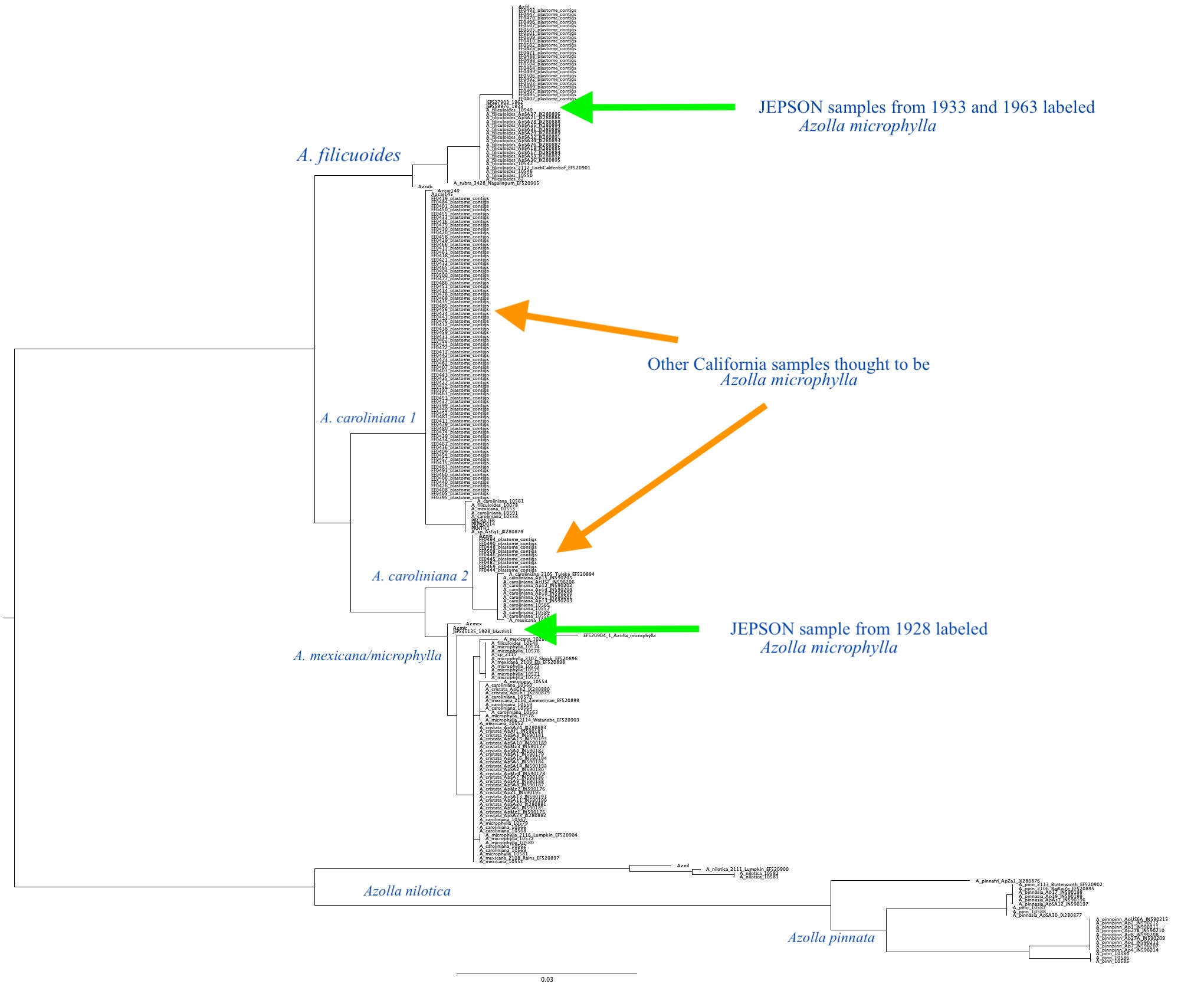
Figure 1. Unpulished Data that I will eventually publish that illustrates some of the current problems. Note that Azolla caroliniana in not monophyletic, that there are more than two taxa in California, and that the species names are all over the place.
Public toolkit
Azolla trnG-trnR alignment
LINK to a nexus alignment of the chloroplast trnG-trnR intergenic spacer region of over 250 samples of Azolla.
If you amplify and sequence the trnG-trnR region for your Azolla sample, you can use this alignment to infer a phylogeny and ID your sample. Please cite me though! :)
You can also mail me a envelope containing a silica dried sample and I will identify it for you, you can reach out to me via email.
Azolla primers
Nagalingum primers
TRNG1F GCGGGTATAGTTTAGTGGTAA
TRNR22R CTATCCATTAGACGATGGACG
Nagalingum, N. S., Schneider, H., & Pryer, K. M. (2007). Molecular phylogenetic relationships and morphological evolution in the heterosporous fern genus Marsilea. Systematic Botany, 32(1), 16-25.
Madeira primers
TrnG43F1 GCCGGAATCGAACCCGCATCA
TrnG63R TTGCTTMTAYGACTCGGTG
Madeira, P. T., Hill, M. P., Dray Jr, F. A., Coetzee, J. A., Paterson, I. D., & Tipping, P. W. (2016). Molecular identification of Azolla invasions in Africa: The Azolla specialist, Stenopelmus rufinasus proves to be an excellent taxonomist. South African Journal of Botany, 105, 299-305.